The Friday Code lifetime deal is currently sold out on AppSumo. Its recorded entry price was $139 for a desktop app builder with 50 monthly credits. This guide helps existing owners understand their limits and helps new buyers compare the product without treating an old price as an available offer.
Friday Code is relevant when you want editable code on your own computer and can take responsibility for deployment and testing. Its historical Tier 2 is the first sensible comparison point for BYOK and broader coding work. Fuzen is a different route for hosted internal business apps; it does not provide the same code portability.
Suitable for
Builders who want to keep their code files; Existing lifetime owners reviewing credit use; Teams able to review generated applications
Consider another option if
The AppSumo lifetime offer is currently sold out.; A credit is not a finished feature or a fixed number of prompts.; Deployment, databases and BYOK can create separate bills.
What comes with the lifetime deal?
Availability
AppSumo offer sold out
Monthly allowance
Credits renew; they are not unlimited
BYOK
OpenRouter from Tier 2
Project files
Stored locally; full code export described
External spending
Hosting, database, domains and provider usage can remain separate
Historical eligibility
New users only, including no prior trials
PLANS AND PRICING
Friday Code plans and pricing
This offer has ended. Historical entitlements below are for existing owners.
PLAN DETAILS
The offer has ended. These are recorded plan details, not an offer you can currently buy.
Friday Code plans and limits · USD
Plan comparison5 plans
Historical basic web tierLicense Tier 1Historical offer
A credit is not a finished feature or a fixed number of prompts.
Deployment, databases and BYOK can create separate bills.
Historical tiers: pay for capabilities before project counts
Tier 1 was $139 with 50 monthly credits and 100 projects. It lists JavaScript and HTML applications and no custom agents. That makes it a restricted starting point, not a cheaper version of every higher-tier capability. A high project count is of little use if each project needs more iteration than the credit pool allows.
Tier 2 was $429, with 250 credits, 500 projects and 10 custom agents. The founder confirms OpenRouter BYOK from this tier. For a solo builder needing broader languages and a way to pay for additional model usage directly, this is the meaningful historical baseline.
Tier 3 was $999 with 500 credits. The founder identifies integrations and automations among the differences from Tier 2. Tier 4 adds team support for up to 5 members and 1,000 credits. Only buy team capacity for actual collaborators, after checking permission and spending controls.
Tier 5 was $2,799, with 1,500 monthly credits, 5,000 projects, 500 custom agents and up to 20 team members. None of these historical options can currently be purchased through the sold-out listing.
The offer was for brand-new users only, explicitly excluding previous accounts, trials and paid plans. Activation was required within 60 days; upgrades were allowed while the deal was live and downgrades within 60 days. If the offer returns, check its new eligibility terms before creating a trial account, rather than assuming that testing first preserves eligibility.
Why 250 credits do not mean 250 completed changes
Friday charges for agent work, including model use and actions. The founder explains that a longer assignment can make many calls and that separate requests can trigger separate deductions. Current documentation directs users to the agent selector for live rates. There is no dependable universal conversion from credits to apps, pages or hours.
A useful evaluation is one complete workflow: add a form, save its data, show errors and verify permissions. Count the initial generation, corrections and final checks together. A cheap first draft followed by repeated repairs may cost more than a larger first run. The credit allowance does not translate into a fixed number of finished apps.
Top-up bundles are available in billing and the documentation says purchased top-up credits do not expire. Auto-refill can trigger further purchases when a balance falls. The current public documentation does not provide a complete top-up price schedule, so treat that as an unresolved cost before enabling automatic purchasing. Monthly included credits and purchased credits should be tracked separately.
Separate the builder bill from the application bill
BYOK means you supply an OpenRouter key and pay for that provider usage. It is useful for model choice or continuing work after the included allowance, but it does not make inference free. Confirm the selected route before a long task: a Friday agent balance and your external provider balance are different budgets.
Publishing a database-backed app can also involve a domain, hosting, database capacity, email delivery and payment processing. An integration makes those services easier to connect; it does not prove their paid plans or usage are prepaid. For a low-traffic prototype, free service allowances may suffice. For customer-facing use, price the intended traffic, storage and transactional email separately.
Keep an export and a recovery path outside the desktop project folder. The ability to keep source code reduces dependence on the editor, but recreating deployment settings, secrets and databases still takes work. Do not put live customer data into a generated app until someone has checked access controls and backup restoration.
Shared credits need a spending agreement
In the Tier 5 question, the founder says teammates cannot see each other’s projects but can see the shared team credits. At that time, per-user credit caps were not available; the reply promised them later. A promised control is not a verified current feature.
Before adding collaborators, establish who may start long-running work and who can enable top-ups. A team allowance is not a guaranteed private budget for every member. If enforceable individual spending limits are mandatory, ask the vendor to demonstrate them on the exact current lifetime plan.
Compare the current subscription separately from the old lifetime offer
Friday’s public pricing currently lists Pro at $20 per month with 100 monthly credits and Max at $100 per month with 500. A year at those listed monthly rates is $240 or $1,200 before extras. These are subscription examples, not equivalent replacements for particular AppSumo tiers: the founder explicitly says the lifetime plans do not map one-to-one to Pro or Max.
It would therefore be misleading to divide the old lifetime price by a rival’s monthly fee and call the result guaranteed savings. Compare the required integration, team controls, model access and workload first. Since the lifetime offer is sold out, the current decision is whether the available subscription or another tool is appropriate—not whether to buy the historical discount.
Friday Code or Fuzen: decide who should host and maintain the app
Choose the Friday Code approach when editable source files and your own deployment path matter. It suits projects that may move to a developer or another editor later. The trade-off is that somebody must understand enough about the finished application to maintain and verify it.
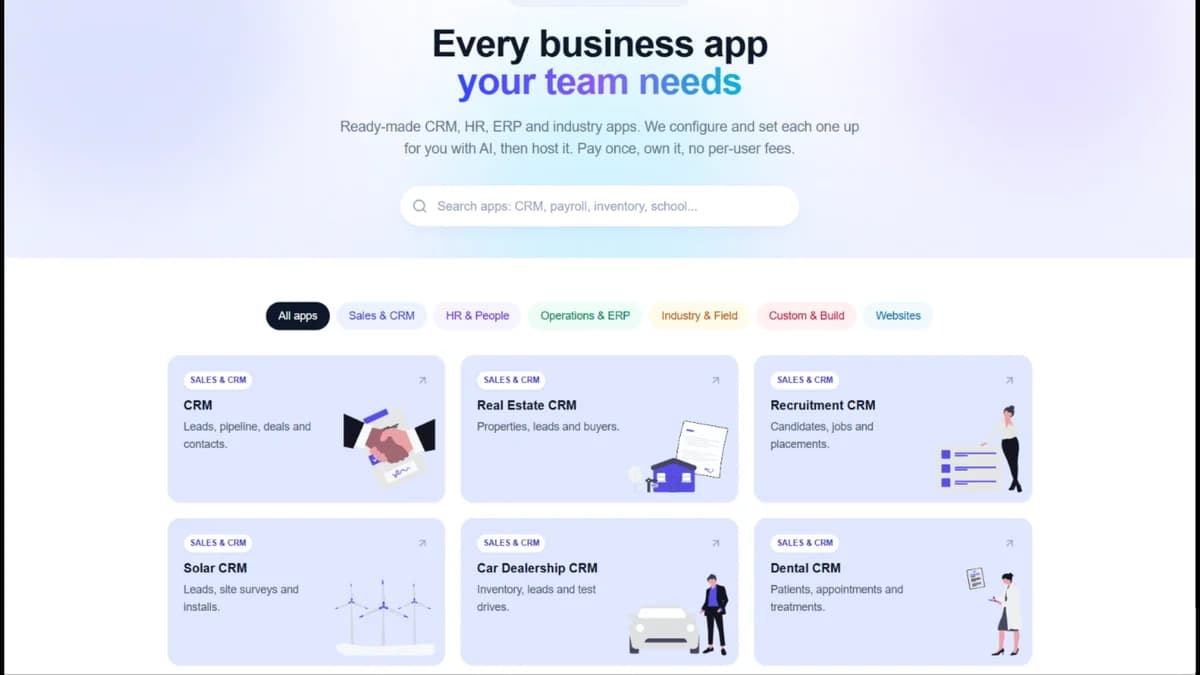
Fuzen is closer to a managed business-application service: its templates and hosted database can reduce setup for an internal CRM or operations tracker. Its AI and runtime allowances remain capped, and it cannot export a standalone source-code application. If a spreadsheet and a simple form already support the process, keep that free setup until the missing workflow justifies a builder.
FEATURE COMPARISON
Features, limits and paid extras
“Included” and “unlimited” can mean different things. This checklist separates full access, usage limits, add-ons and features that are not confirmed.
Feature coverage3 / 8
3 fully included · 3 limited · 0 add-on · 0 not included · 2 not confirmed. Coverage is not a quality score.
Features are grouped by documented coverage. “Not confirmed” means the evidence is incomplete, not that a feature is absent.
App builders: documented features and conditions
FEATURESFeature comparison
Friday CodeLifetime offer ended
Included3 features
AI app generationBuild or change apps with AI assistance
Included
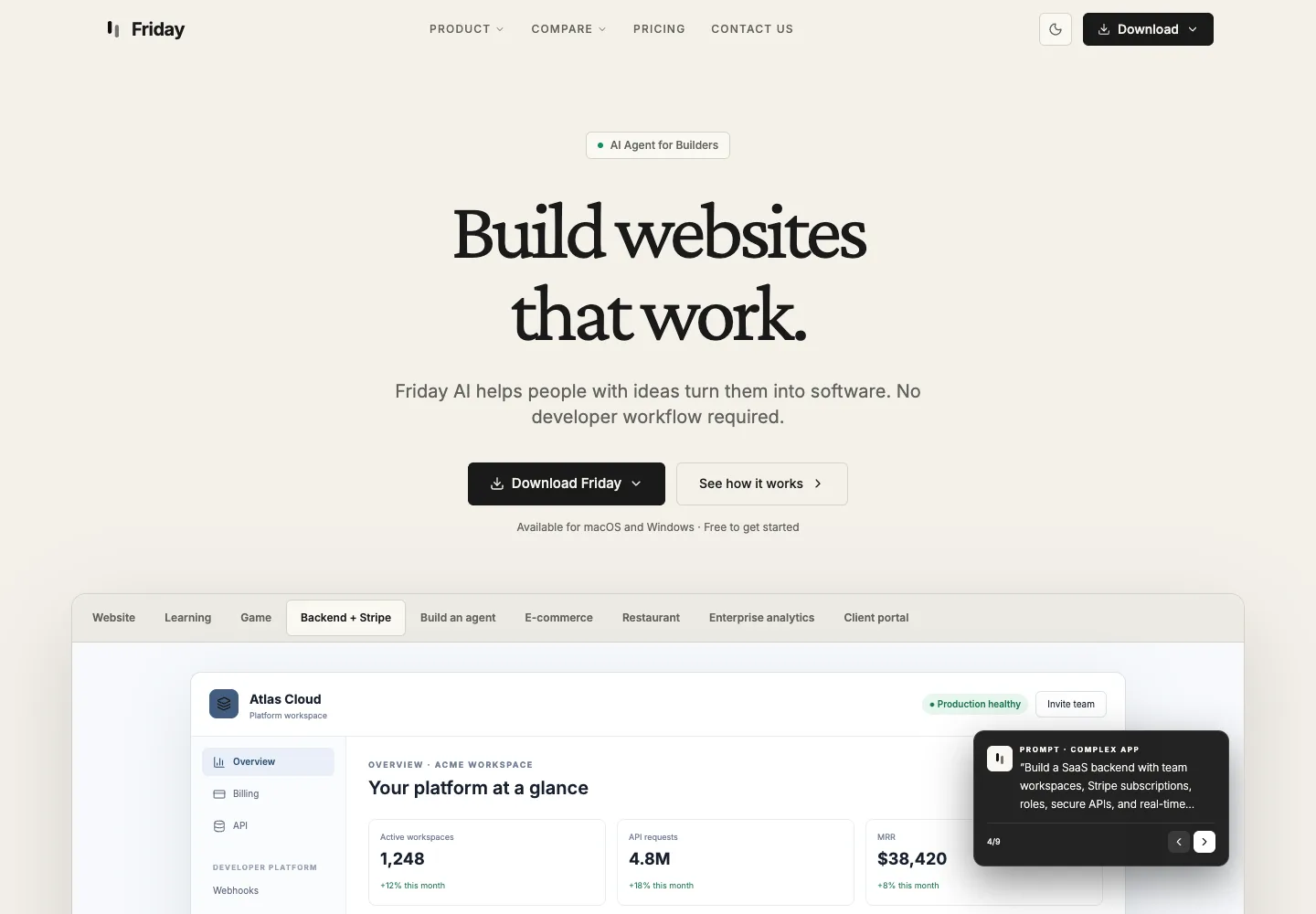
Desktop agent generates and revises application code.
Business templatesStarting points for business workflows
Included
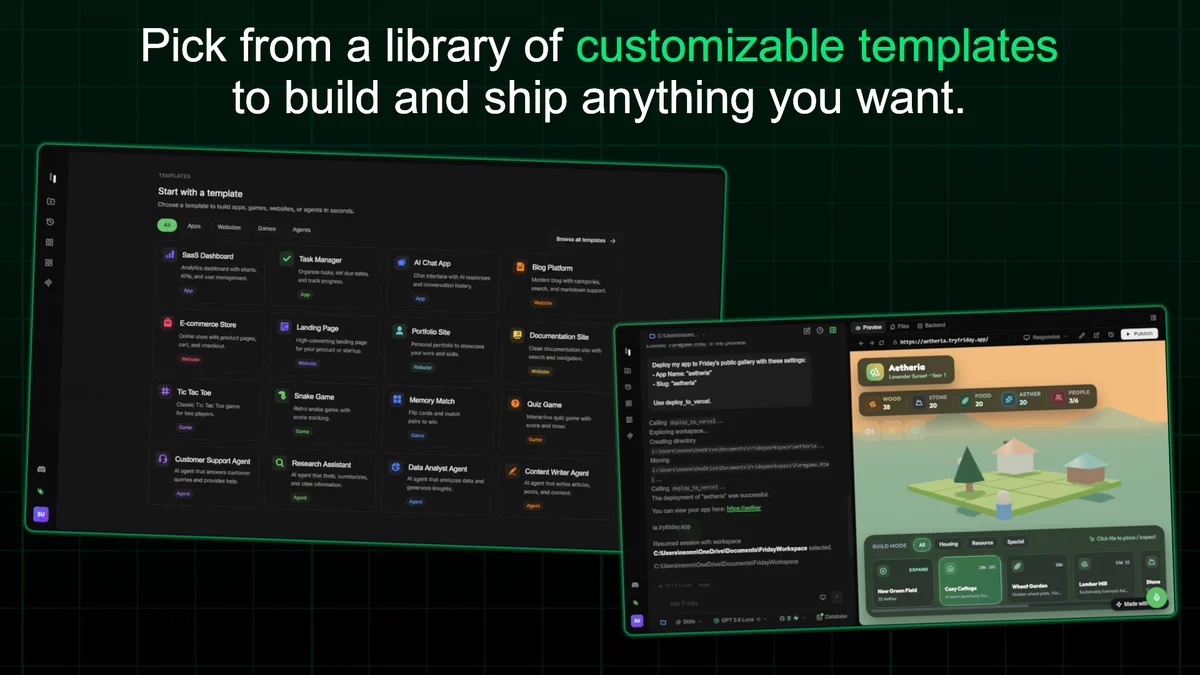
App and website starter templates; not a ready-made ERP guarantee.
Code exportSource-code ownership and portability
Included
Full codebase export and local project storage are explicitly described.
Limited3 features
Hosted backendDatabase and server services
Limited
Supabase and deployment integrations connect external services; hosting allowances are not established by the lifetime purchase.
Own AI API keyUse a separately billed model account
Limited
OpenRouter BYOK starts at Tier 2 according to the founder.
Team accessBuilder and end-user allowances
Limited
Team access begins at Tier 4; per-user credit caps were not available in the founder answer.
Not confirmed2 features
Custom domainPublish under your own domain
Not confirmed
Domain registration and hosting terms depend on the deployment service.
Client use and resaleCommercial and client-delivery scope
Not confirmed
Code export is established; a specific client-resale licence is unclear.
Check each product’s plan notes for tier limits and additional costs. Feature coverage is not a quality rating.
USE CASES
What problems does Friday Code solve?
01
Turn a defined app idea into an editable project
A founder needs a working prototype but wants to retain the files for later development.
How to use it
Describe the users, data and one complete task the app must perform.
Generate a small version, review the preview and ask for focused changes.
Export or back up the code, then verify the deployment and data permissions.
What this helps you do: The documented workflow produces code that can continue outside the builder.
Limitations: Generated output still needs functional and security review. A working preview is not proof that payments or permissions are correct.
02
Continue an existing project without rebuilding from a blank prompt
A team has source files from another builder and wants a desktop assistant to make changes.
How to use it
Back up the original project and describe its current stack.
Use a tier with project import and the necessary language support.
Ask for one bounded change and review its diff and tests before accepting another.
What this helps you do: The founder describes importing projects from existing tools and continuing work locally.
Limitations: Dependencies, external accounts and a failed build can require troubleshooting; project capacity does not measure how much AI work is included.
BUYER FEEDBACK
What buyers say
Buyer experiences can vary with the plan, product version and workflow.
Mixed feedback
Useful output still required iteration and support
The five newest visible reviews include a Tier 3 buyer reporting a micro-SaaS build and early MCP reliability problems resolved with support, a buyer reporting account access trouble, and a positive homepage-prototype review that requested better font and contrast controls. These individual reports do not guarantee production readiness.
The exact AppSumo listing currently says sold out. Recorded prices and limits on this page describe the historical offer.
Can I use my own model key?
The founder confirms OpenRouter BYOK from Tier 2. External provider usage is billed separately.
Is Friday Code hosting included for every project?
The offer describes local projects, code export and integrations. It does not establish unlimited prepaid hosting, database storage or email delivery for every deployed app.
Does the lifetime offer include future Max subscription features?
The founder says lifetime plans are not mapped to Pro or Max. Use the AppSumo tier terms and listed features rather than importing subscription benefits.