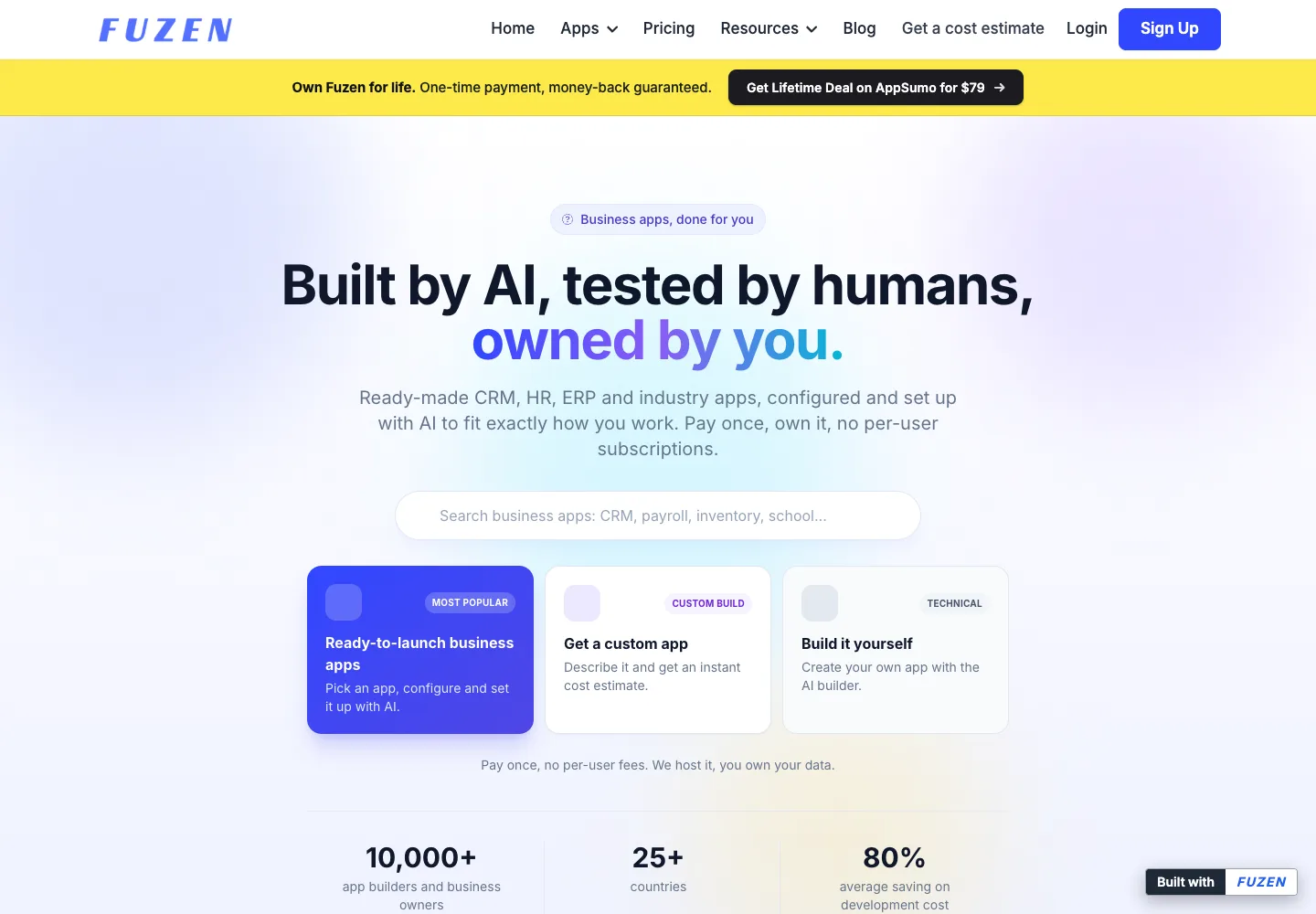
The Fuzen lifetime deal starts at $79 for 2 hosted apps. Its 100 monthly AI credits are capped at 10 per day; they are not a fresh daily allowance on top. Running the finished app also uses separate server and request quotas.
Fuzen is a plausible choice for an internal CRM or operations tracker when managed hosting is more useful than owning deployable code. Tier 1 suits one or two light-use apps; Tier 2 provides more practical room for multiple workflows and is the safer starting point if BYOK is required. Skip it when independent hosting or source-code export is essential.
Suitable for
Small businesses replacing spreadsheet-based workflows; Internal CRM and operations apps with defined requirements; Buyers comfortable keeping apps on Fuzen hosting
Consider another option if
No source-code or app-structure export for self-hosting.; AI, server, requests, data rows and storage are separate allowances.; Premium templates, external API use and extra capacity can cost more.
What comes with the lifetime deal?
AI budget
Monthly pool plus daily usage cap
Hosting budget
Shared across all apps in the account
Export
Data export, not source-code export
Templates
Premium templates remain paid
Additional capacity
Some add-ons recur monthly
PLANS AND PRICING
Fuzen plans and pricing
Prices and allowances are shown for each plan below.
PLAN DETAILS
Compare each plan’s price and allowance. Confirm any limit marked ‘Not specified’ before buying.
Fuzen plans and limits · USD
Plan comparison3 plans
One or two small internal appsLicense Tier 1
Several workflows with own-provider optionsLicense Tier 2
Larger account-wide resource needsLicense Tier 3
PriceUSD
$79one-time
$159one-time
$299one-time
Billing
One-time payment
One-time payment
One-time payment
Monthly AI credits
100credits/month
300credits/month
800credits/month
Daily AI credit cap
10credits/day
30credits/day
100credits/day
App slots
2apps
5apps
10apps
Monthly server credits
5,000credits/month
50,000credits/month
200,000credits/month
Monthly requests
5,000requests/month
50,000requests/month
200,000requests/month
Stored data rows
5,000rows
50,000rows
200,000rows
Storage
3GB
15GB
50GB
Who this tier fits
Light-use trackers with limited records and modest editing.
Up to five app slots and substantially higher shared runtime capacity.
Six to ten apps or capacity beyond Tier 2.
Keep in mind
Daily/monthly AI caps and Tier 1 BYOK ambiguity.
Premium templates and provider use remain extra.
No source export; resources are shared, not multiplied per app.
Plan notes
Runtime capacity is shared across apps, not multiplied by app count.
Tier 1 BYOK conflicts with founder and official plan details; confirm entitlement.
Deal terms say no stacking; newer founder stacking guidance conflicts.
Runtime capacity is shared across apps, not multiplied by app count.
Premium templates are separate purchases with a stated 50% discount.
Deal terms say no stacking; newer founder stacking guidance conflicts.
Runtime capacity is shared across apps, not multiplied by app count.
Premium templates are separate purchases with a stated 50% discount.
Deal terms say no stacking; newer founder stacking guidance conflicts.
Select the final tier on AppSumo. The product link opens the same listing for every tier.
No source-code or app-structure export for self-hosting.
AI, server, requests, data rows and storage are separate allowances.
Premium templates, external API use and extra capacity can cost more.
Choose by the first capacity limit you will reach
Tier 1 costs $79 and includes 2 apps, 5,000 stored rows and 3 GB. It can fit a small internal tracker, but start by counting records and attachments already in use. A database near its cap before you launch leaves little room for growth or audit history.
Tier 2 costs $159 and raises the account to 5 apps, 50,000 rows and 15 GB. Its monthly AI pool is 300 credits, capped at 30 in one day. This is a more credible starting point for several departments or substantial initial changes, especially when own-provider keys are needed.
Tier 3 costs $299 for 10 apps, 200,000 rows and 50 GB. Its 800 monthly AI credits do not create unlimited runtime. Choose it when a measured app, record or workload requirement exceeds Tier 2, rather than assuming every team needs the largest plan.
Activation is required within 60 days and the licence carries the stated 60-day refund window. Upgrades are permitted while the deal is available and downgrades within 60 days. Credit add-ons are separately marked non-refundable, so avoid treating a licence refund policy as a refund promise for purchased usage.
Daily caps do not multiply the monthly allowance
The founder’s credit clarification uses Tier 2 as the example: the daily cap permits a concentrated building session, but the monthly pool remains the total. Spending the daily maximum for ten days would exhaust that pool. The remaining days of the month do not add another daily allocation.
Current pricing documentation says AI messages and integration actions can use credits, with cost varying by model and action. This makes “one prompt equals one credit” an unsafe planning rule. A detailed initial request, several corrections and an integration fix are one business outcome but several chargeable steps.
The official pricing page says plan credits reset monthly without rollover. Purchased packs are separate and do not expire. AppSumo’s listed 100-credit add-on is $15 and non-refundable; the founder confirms it is a one-time balance, not an increase to every future day or month. The direct site also lists other pack sizes. Check the current account purchase screen rather than assuming every checkout offers identical packs.
The finished app has its own operating budget
App count is only one dimension. Server credits cover server-side work such as workflows and background actions; requests measure app activity such as screen loads and data operations. Heavier work can use more server credits while still being one request. Neither counter is the same as the AI building balance.
The founder confirms that hosting resources are cumulative across the workspace. If two apps together store 4,800 rows on Tier 1, their remaining room is 200 rows—not another 5,000 for each app. Likewise, ten apps on Tier 3 share the displayed capacity rather than each receiving it.
A request forecast is necessarily approximate. Suppose twenty staff each cause ten billable requests on twenty working days: that is 4,000 requests before background jobs, public traffic or additional reads and writes. This is a budgeting example; a single screen can create more than one operation. Watch actual counters during evaluation.
A September founder answer describes an alert and two-week grace period after hosting limits are crossed, with upgrading or extra capacity as options. Treat that as dated guidance, not a contractual uptime guarantee. Ask what the app does after the grace period and who receives the billing alert before making it a critical business system.
One updated buyer report describes earlier invented test results and incorrect data flow, then a substantially improved rebuild. Treat that as a reason to check the actual output: submit a known input, inspect the stored record, verify the returned value and repeat with a user who should not have access. An AI-generated “passed” message is not a substitute for observing the app.
Lifetime access can still have monthly add-ons
Fuzen currently lists an additional 100 GB of storage at $5 per month and one million additional database rows at $15 per month. Those are standing capacity charges. Keeping both for twelve months would add $240 to the licence cost, before tax or other services. More space is not free simply because the core licence is lifetime.
The same page lists separate one-time packs of one million page requests for $499 and one million server credits for $499. These replenish different counters; buying one does not replenish the other. Confirm applicability and current purchase options for your lifetime account before using those prices in a client quote.
Premium templates are another cost. The founder says paid Manufacturing ERP, School and Solar templates are not included free, even on Tier 3; Tier 2 and Tier 3 receive a 50% discount. Confirm the exact template and checkout total before buying a licence around it. A large template catalogue is not the same as a catalogue of included templates.
External APIs can create additional bills. With BYOK, provider calls use your provider account rather than Fuzen’s AI pool, according to the founder. The platform’s runtime and storage limits still apply. Domains, messaging providers, payment processing and custom development services should be budgeted separately where the workflow needs them.
Clarify Tier 1 BYOK before relying on it
AppSumo displays BYOK in the Tier 1 feature list. However, the founder’s detailed answer ties own-model keys to Tier 2 and Tier 3, and the direct pricing page lists BYOK under Growth rather than Starter. This is an entitlement conflict, not a reason to promise Tier 1 BYOK.
For planning, choose Tier 2 if direct AI-provider billing is essential, or obtain explicit confirmation of the Tier 1 licence before purchase. The current deal maps Tier 1 to Starter and Tiers 2–3 to Growth future updates, so Tier 3 should not automatically be described as the direct Business subscription just because some capacity numbers resemble it.
Data ownership does not provide an exit-ready application
Fuzen’s founder confirms CSV or Google Sheets data export but no source-code or app-structure export. You can retain records, but moving away requires rebuilding the app logic, views and workflows elsewhere. If a client requires source delivery or self-hosting, this is a reason to choose a different tool.
For separate branded client installations, the founder says each deployed app uses a slot. A multi-tenant design inside one app is possible, but shares the app’s branding and requires deliberate permissions. Shared infrastructure is not the same as a separate server or database for every customer.
An October founder reply permits selling the apps you build while prohibiting transfer of the lifetime licence. Older template-related guidance and competing reviews describe narrower rights. Get the chosen template’s resale terms in writing rather than applying a broad marketing claim to every paid template.
The founder also states that hosting is in the US and that a DPA was not in place in the October reply. If your customer requires particular data locations or contractual processing terms, settle those requirements with the vendor before uploading their records. Confirm compliance requirements for the particular app and data involved.
FEATURE COMPARISON
Features, limits and paid extras
“Included” and “unlimited” can mean different things. This checklist separates full access, usage limits, add-ons and features that are not confirmed.
Feature coverage4 / 8
4 fully included · 3 limited · 0 add-on · 1 not included · 0 not confirmed. Coverage is not a quality score.
Own AI API keyUse a separately billed model account
Limited
Founder and direct pricing tie BYOK to Tier 2/3; Tier 1 listing wording conflicts.
Client use and resaleCommercial and client-delivery scope
Limited
Latest founder reply permits client apps, not LTD transfer; confirm rights for a chosen premium template.
Not included1 feature
Code exportSource-code ownership and portability
Not included
CSV/Google Sheets data export does not export source code or app structure.
Check each product’s plan notes for tier limits and additional costs. Feature coverage is not a quality rating.
USE CASES
What problems does Fuzen solve?
01
Replace a scattered lead-and-quote spreadsheet process
A business keeps prospects, quotes and follow-up approvals in separate sheets and messages.
How to use it
List the records, status changes and people allowed to approve each step.
Start with a relevant CRM template or describe the workflow to the builder.
Import a sample CSV, assign roles and check a lead from intake through approval before importing the full list.
What this helps you do: Fuzen’s documented database, role and workflow tools can bring the process into one hosted application.
Limitations: A template still needs configuration. Stored rows and repeated screen requests consume shared capacity; customer access rules need actual testing.
02
Give staff a controlled inventory or service tracker
Staff need a consistent way to record work without editing every column in a shared spreadsheet.
How to use it
Define the item or service record and the views each role needs.
Build a small app and configure forms, status changes and any external connection.
Check a complete update and export cycle with sample records before wider rollout.
What this helps you do: A browser app can expose a narrower task-based interface than the original spreadsheet.
Limitations: Separate client branding consumes additional app slots. Complex automation can consume more server credits than a simple request.
BUYER FEEDBACK
What buyers say
Buyer experiences can vary with the plan, product version and workflow.
Mixed feedback
Support helps, but early progress is not a deployment guarantee
The five newest visible reviews include two marked incentivized. One buyer reports support fixing a stuck feature and replenishing credits after a difficult repair. A detailed updated review describes earlier data-flow, generated-result and security concerns, followed by a later report of major improvement and repurchase. These individual reports do not establish the security of every generated app.
Fuzen images
Choose managed business apps or portable source code
Fuzen makes more sense than a desktop code generator when your goal is an internal operational app and you want hosting and database management handled by the platform. Friday Code offers the opposite trade: local editable source files, but greater responsibility for the deployed application and external services. Its AppSumo offer is currently sold out.
For a very small workflow, keep a spreadsheet or try Fuzen’s published free plan before buying. The free tier has limited capacity, community publication and branding; it should not be assumed suitable for private customer records. A private paid app and a public experiment have different requirements.
The lifetime terms say no stacking, while a newer founder answer suggests stacking multiple deals for more apps. Do not promise twenty or thirty apps from that answer alone. Resolve it before ordering additional licences. Also avoid a precise subscription-savings claim: the current direct pricing page shows different figures in its plan cards and FAQ, and future-plan mapping is not identical to every current subscription.
No. Its daily cap is 30, within a 300-credit monthly pool. The founder explicitly distinguishes the daily ceiling from the monthly total.
Are hosting limits per app?
No. The founder says the workspace shares hosting resources across all its apps. App count does not multiply requests, rows, storage or server credits.
Can I download my app and host it elsewhere?
No source-code or app-structure export is documented. Data can be exported, but independently hosting the application would require rebuilding it.
Are paid templates free on Tier 3?
No. The founder says premium templates remain separate purchases; Tiers 2 and 3 receive a 50% discount.
Can I stack licences for more apps?
The offer says no stacking, while a newer founder answer says multiple deals can be stacked. Obtain a written clarification before paying for that arrangement.