
Recommended tools and plans
Choose for repeatable monthly work, then check research depth and concurrency.
For a small recurring extraction pipeline
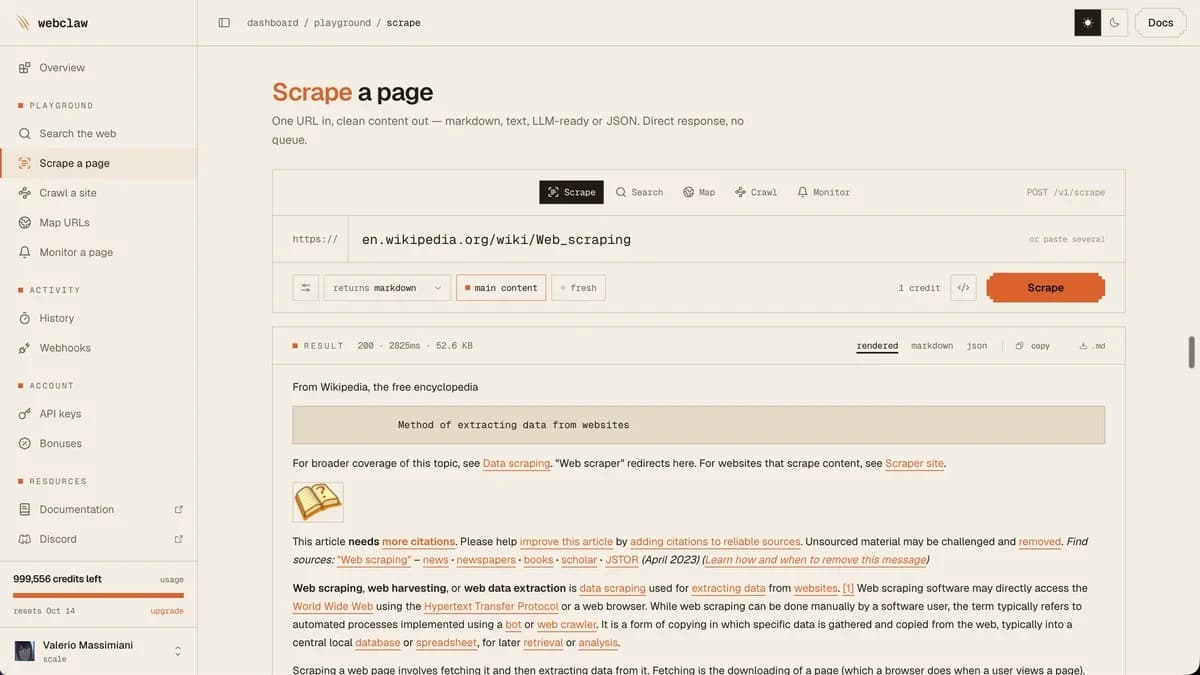
Webclaw
Tier 1 is a starting candidate with 5,000 monthly credits, 8 research runs and 10 concurrent requests. Choose it only when the recurring collection and follow-on actions fit without depending on the one-time bonus.
Keep in mind: A credit is not a promise of a usable page from every site. Search results and extra processing can add charges; check the actual target pages and returned fields before planning a recurring job.
Buy nowExplore Webclaw’s features and plansPrice the complete collection job
Write down how a URL becomes a usable record: discover pages, fetch content, extract fields, and run any further processing. A workflow that searches and summarizes can consume more than a basic page fetch. Estimate the whole chain before comparing monthly credit totals.
For example, monitoring 100 known pages once a day creates about 3,000 planned fetches in a 30-day month, before extra actions or retry behavior. This is a workload assumption, not a guaranteed credit bill. Check which endpoints you will use and leave room for unsuccessful or repeated work.
Keep the initial import separate from monthly monitoring
A launch bonus can help populate a new project, but the recurring allowance must sustain the next ordinary month. Webclaw also limits research runs, sources per run and concurrency. Raising page credits alone will not help a job blocked by one of those limits.
Before relying on an extraction pipeline, inspect sample output from the exact pages you are allowed to access. Check missing fields, dates and formatting. A clean response from one simple page is not proof that every changing or protected site will work.
Feature comparison
Use the same checklist for each tool. Plan limits, paid extras and features that need confirmation are shown separately.
Features are grouped by documented coverage. “Not confirmed” means the evidence is incomplete, not that a feature is absent.
Check each product’s plan notes for tier limits and additional costs. Feature coverage is not a quality rating.
Buying questions
Can I treat every credit as one finished record?
No. A basic page request and a multi-step search, extraction or summary workflow can have different consumption. Count the actions needed to produce a useful record, not just the final rows.
Does the one-time bonus make a smaller monthly tier sufficient?
Only for one-time work. A recurring job must fit the renewing credits and the separate research and concurrency limits without repeatedly drawing on a finite bonus.
When should I move up a Webclaw tier?
Identify the exact constraint first: monthly credits, research runs, research depth or concurrent requests. Move up only when the next plan resolves that constraint for the sites and outputs you need.