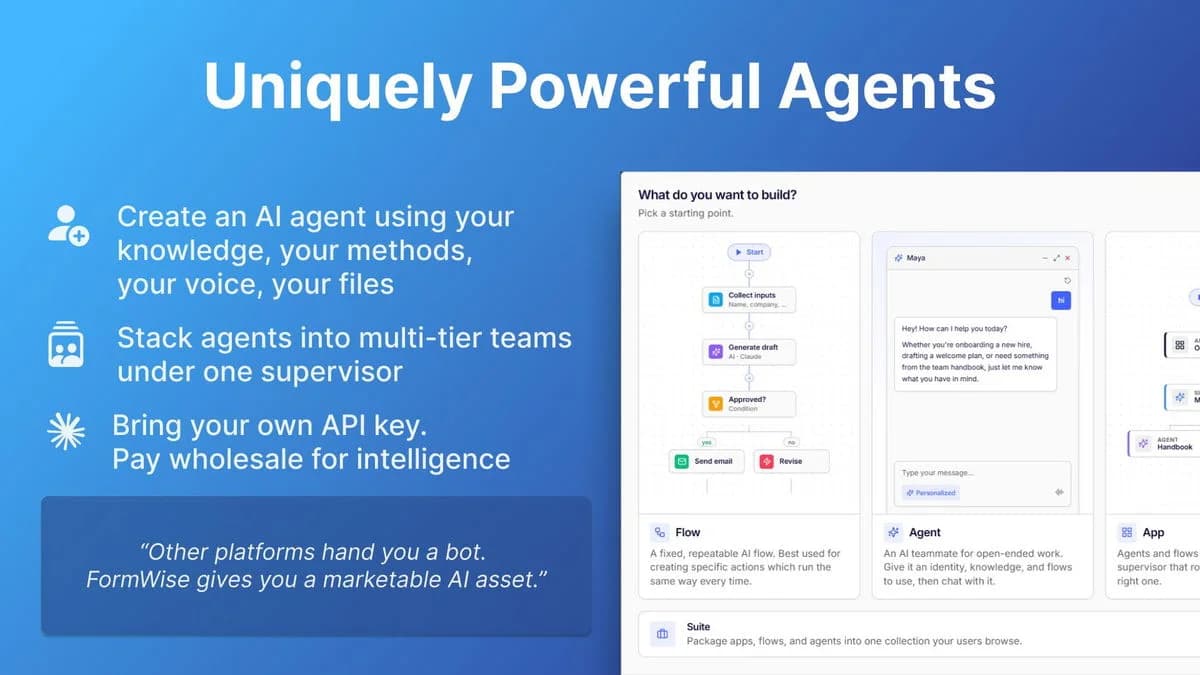
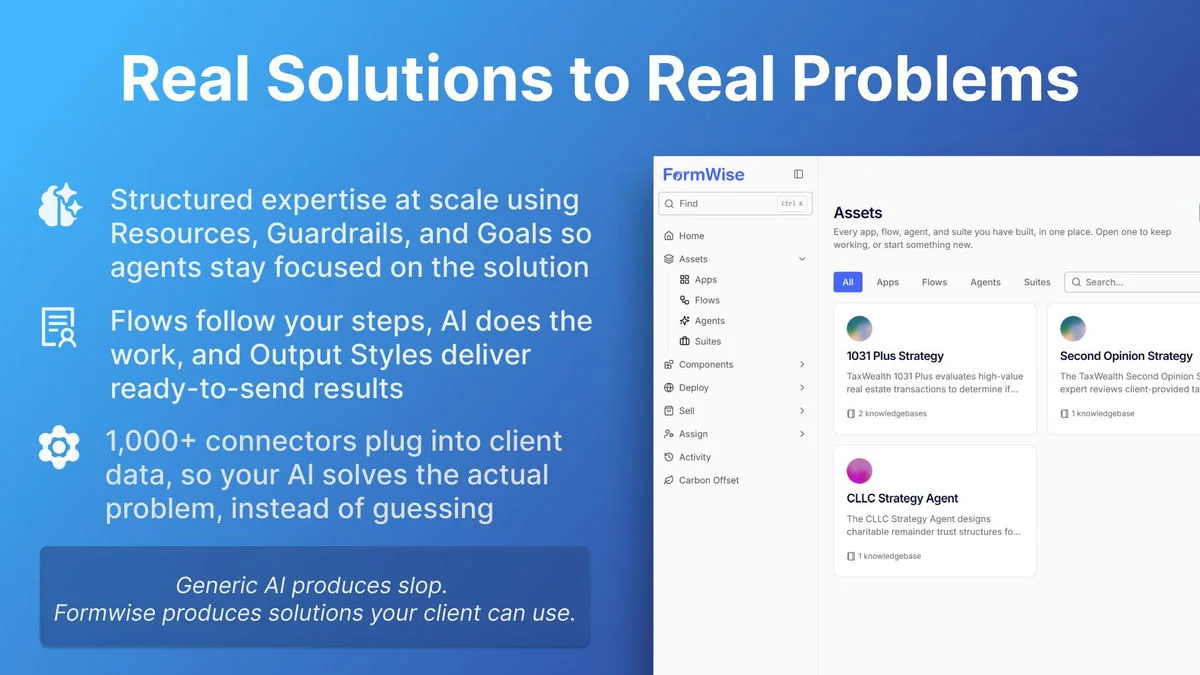
The Formwise lifetime deal starts at $49, but its included credits are a starter balance, not a monthly refill. Tier 2 is the first plan with bring-your-own-key access. Tier 3 adds white-labeling and native HighLevel integration, which can matter more than a larger credit balance.
For a paid client service, start the comparison at Tier 2 for BYOK or Tier 3 for white-labeling. Tier 1 suits a small hosted-credit pilot; it is a poor assumption for unlimited low-cost client usage.
Suitable for
Consultants turning a repeatable method into a client-facing tool Agencies needing white-label AI portals or HighLevel integration
Consider another option if
Included credits are not a monthly allowance. BYOK starts at Tier 2 and white-labeling at Tier 3. Portal revenue still has model, platform and payment-processing costs.
What comes with the lifetime deal?
Credit renewal
Included AppSumo credits are one-time
BYOK threshold
Tier 2 and above
White-label and HighLevel
Tier 3 and above
Client billing
Usage, platform and Stripe costs remain relevant
Refund and redemption
60-day refund and activation windows
PLANS AND PRICING
Formwise plans and pricing
Prices and allowances are shown for each plan below.
PLAN DETAILS
Compare each plan’s price and allowance. Confirm any limit marked ‘Not specified’ before buying.
Formwise plans and limits · USD
Plan comparison4 plans
Small hosted-credit pilotLicense Tier 1
Provider keys and small-team toolsLicense Tier 2
White-label agency deliveryLicense Tier 3
Larger asset library and organizationLicense Tier 4
PriceUSD
$49one-time
$159one-time
$309one-time
$529one-time
Billing
One-time payment
One-time payment
One-time payment
One-time payment
Team seats
1users
3users
15users
Unlimitedusers
One-time credits
1,000credits once
3,500credits once
8,500credits once
15,000credits once
Memories per customer
3memories
10memories
Unlimitedmemories
Unlimitedmemories
Toolsets
3toolsets
10toolsets
Unlimitedtoolsets
Unlimitedtoolsets
Knowledge bases
1knowledge bases
3knowledge bases
10knowledge bases
Unlimitedknowledge bases
Sources per knowledge base
3sources
10sources
15sources
Unlimitedsources
Who this tier fits
One editor testing a limited set of forms and knowledge sources.
A few editors who need BYOK, portal MCP and more sources.
Branded client tools with native HighLevel and more editors.
A business exceeding Tier 3 resource limits.
Keep in mind
No BYOK; credits are one-time.
White-labeling and native HighLevel are not included.
Knowledge bases and sources still have ceilings; client runs are not free.
Confirm the end-user connector release and portal security requirements before promising them.
Plan notes
Credits do not replenish monthly.
BYOK excluded; budget hosted usage after the one-time balance.
White-labeling is not included.
Credits do not replenish monthly.
BYOK included.
White-labeling is not included.
Credits do not replenish monthly.
BYOK included.
White-labeling and native HighLevel included.
Credits do not replenish monthly.
BYOK and portal MCP require Tier 2 or above.
White-labeling and native HighLevel integration require Tier 3 or above.
Tier 4 integration connector is described as beta in founder answers; verify release before relying on it.
Select the final tier on AppSumo. The product link opens the same listing for every tier.
BYOK starts at Tier 2 and white-labeling at Tier 3.
Portal revenue still has model, platform and payment-processing costs.
Choose the first tier that supports your delivery model
Tier 1 costs $49 and supplies 1,000 one-time credits, 1 knowledge base and 3 toolsets. It can establish whether a guided tool is useful, but has no BYOK. After the balance is spent, hosted usage needs another payment arrangement.
Tier 2 costs $159 and adds BYOK, portal MCP, conversational voice and workspace analytics, with 3 organization seats. It is the practical starting point when you want direct provider billing rather than depending solely on the starter balance.
Tier 3 costs $309 and adds white-labeling, native HighLevel integration, advanced analytics and the AI quality checker. Its 15 seats and 10 knowledge bases suit an agency with defined client assets. Tier 4 removes several resource ceilings. Buy that capacity for known needs, not for the end-user integration connector while its release remains uncertain.
One-time credits are different from subscription allowances
The AppSumo plan table explicitly labels its balances one-time. Do not transfer the recurring Pro or Agency allowances from a normal subscription pricing page to this deal. Building and publishing a tool is different from running it: a model call and added actions can consume credits when a user actually uses the tool.
The model picker shows usage costs, and actions such as web search can add to a run. A long multi-step flow may make several calls. Forecast your costs from completed client tasks, including retries and retrieval, rather than calling one credit one answer.
Tier 2 and higher let you connect supported provider keys. Those providers then bill the relevant AI requests; the lifetime payment does not prepay that bill. Hosted on-demand usage is the other route. Set a spending limit and check which actions remain platform-metered for your exact configuration.
In an October 29 founder reply, on-demand credits are quoted at $0.009 each. At that quoted rate, 1,000 additional credits cost $9 before any applicable charges; this is a cost example, not a guarantee of a fixed number of outputs. The founder notes that some conversations use a fraction of a credit while expensive models can use dozens. Recheck the live rate before enabling paid usage.
Price client access after usage and transaction fees
Formwise supports paid or free portal plans, client allowances and Stripe payments. Current documentation describes a pricing receipt that subtracts Stripe and platform fees and the credits at the on-demand rate. A monthly price is therefore revenue, not profit. Exact fees and live model rates must be checked before offering unlimited access.
Portal customers and organization editors serve different purposes. An employee editing tools uses the organization role arrangement; a customer running a published tool uses the access and allowance you assign. Neither means a separate private Formwise workspace is included for every client.
Client groups and subscription plans also differ: current documentation says runs by users who access an asset through an assigned group without a live plan draw from organization credits. Set a real usage allowance for paying customers, and account for internal access that draws on your own balance.
Check the intake and branching pattern before selling a workflow
An October 26 buyer review describes a forward-only flow and workarounds for repeated steps, mid-flow questions and conditional routing. The buyer also distinguishes the conversational intake inside a flow from a regular-looking portal form. These reported design constraints matter if your service requires a client to return to earlier answers.
Sketch the complete interaction before buying: all initial questions, any missing-information request, classification branches, human review and final delivery. Confirm the current editor supports that sequence. A generic claim that the product builds agents does not establish a loop, a pause for human input or enforcement of every field limit.
Separate released features from the reason to upgrade
The pricing matrix includes a Tier 4 integration connector. An October founder answer calls that end-user connection feature beta and available upon release. Do not sell a client service that relies on it until the required account connection works and the vendor confirms availability.
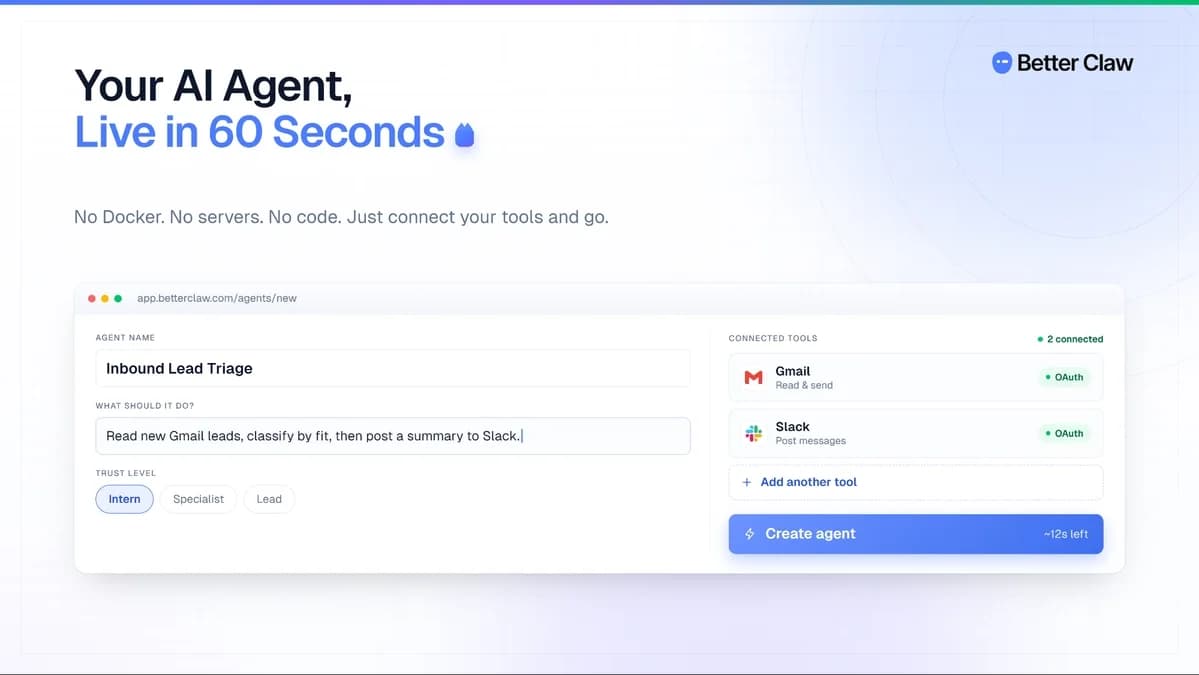
WorkLLM is a different choice for employees sharing models, organization memory and a monthly allowance. BetterClaw focuses on hosted agent runtime with a separate model connection. Formwise is more relevant when the deliverable is your own client-facing tool, but its portal setup and usage economics deserve attention before the purchase.
FEATURE COMPARISON
Features, limits and paid extras
“Included” and “unlimited” can mean different things. This checklist separates full access, usage limits, add-ons and features that are not confirmed.
Feature coverage2 / 5
2 fully included · 3 limited · 0 add-on · 0 not included · 0 not confirmed. Coverage is not a quality score.
Features are grouped by documented coverage. “Not confirmed” means the evidence is incomplete, not that a feature is absent.
Workflow automation: documented features and conditions
FEATURESFeature comparison
FormwiseLifetime deal
Included2 features
Task executionHow a workflow starts and runs.
Included
Structured flows, agents and reusable toolsets for internal users or clients.
Device supportWhere workflows can be controlled.
Included
Browser-based builder with embedded tools and client portals.
Limited3 features
App connectionsAvailable connections and permission boundaries.
Limited
BYOK and portal MCP start at Tier 2; native HighLevel starts at Tier 3. Tier 4 end-user connector release needs confirmation.
AI usageHow AI consumption is paid for.
Limited
One-time credits, followed by paid on-demand usage or external model billing with BYOK on Tier 2+.
Team accessSeats, account sharing and roles.
Limited
Organization seat and knowledge-base allowances differ by tier; client access is not a separate workspace licence.
Check each product’s plan notes for tier limits and additional costs. Feature coverage is not a quality rating.
USE CASES
What problems does Formwise solve?
01
Turn a repeated client assessment into a guided tool
A consultant repeatedly collects the same inputs and writes the same type of assessment.
How to use it
Create a structured input form and define the required output.
Attach the relevant knowledge and chain the processing steps into a flow.
Publish through an embed or portal and review sample outputs before charging clients.
What this helps you do: A client can submit inputs through a repeatable process rather than a private prompt exchange.
Limitations: Prompt design and output review remain necessary. A running flow consumes credits or provider usage.
02
Offer an assistant based on your own reference material
A generic chatbot does not know the methods, policies or documents your clients use.
How to use it
Prepare the documents and separate materials that should not share access.
Assign sources to a knowledge base and configure the agent.
Restrict access, test retrieval and set each customer allowance.
What this helps you do: The documented setup makes your material available through an interactive tool.
Limitations: Source limits, organization seats and portal permissions differ. A knowledge base does not guarantee accurate or complete answers.
BUYER FEEDBACK
What buyers say
Buyer experiences can vary with the plan, product version and workflow.
Mixed feedback
Deployment is not the same as a finished client service
An October buyer gives detailed examples of flow limitations and confusion between conversational intake and a conventional portal form. The same buyer describes finding a workable portal route. Several other reviews are early impressions rather than long-term results; an older HighLevel Reddit discussion predates the current tiers.
No. The current AppSumo plan table describes one-time credits. Standard subscription allowances should not be applied to this offer.
Which tier includes white-labeling?
Tier 3 and Tier 4 include white-labeling. Lower tiers do not include it; any separately offered add-on needs its own price check.
Does BYOK make the service free to run?
No. Provider requests create an external AI bill. Check the usage treatment of any additional platform actions and the payment costs of selling client access.