The ProductBridge lifetime deal starts at $69 for a small product team. Its appeal is connecting feedback to roadmaps and customer follow-up; the deciding limits are staff, organizations, support volume and metered AI.
ProductBridge suits SaaS teams that want support conversations and product requests connected to the same customer. Tier 1 covers a small feedback operation; Tier 2 is the practical starting point for segmentation, insights and custom API work. Choose multi-organization tiers for separation, not an assumed unlimited AI budget.
Suitable for
Small SaaS teams collecting product feedback; Teams connecting support context to a roadmap; Multi-product organizations with defined permissions
Consider another option if
AI credits remain metered despite unlimited boards.; API/webhooks and insights start at Tier 2.; New-user eligibility excludes existing trials.
What comes with the lifetime deal?
Purchase
One-time licence; listed limits still apply
Main decision
AI credits remain metered despite unlimited boards.
PLANS AND PRICING
ProductBridge plans and pricing
Prices and allowances are shown for each plan below.
PLAN DETAILS
Compare each plan’s price and allowance. Confirm any limit marked ‘Not specified’ before buying.
ProductBridge plans and limits · USD
Plan comparison4 plans
Small product teamLicense Tier 1
One growing SaaSLicense Tier 2
Up to three organizationsLicense Tier 3
Four to ten organizationsLicense Tier 4
PriceUSD
$69one-time
$149one-time
$329one-time
$549one-time
Billing
One-time payment
One-time payment
One-time payment
One-time payment
Organizations
1organizations
1organizations
3organizations
10organizations
Team members per organization
3members
10members
15members
15members
Monthly AI credits per organization
200credits/month
500credits/month
500credits/month
500credits/month
One-time bonus AI credits
200credits
500credits
500credits
500credits
Monthly support conversations
150conversations/month
500conversations/month
Unlimitedconversations/month
Unlimitedconversations/month
Help center articles
100articles
500articles
Unlimitedarticles
Unlimitedarticles
Active surveys
3surveys
10surveys
25surveys
Unlimitedsurveys
Who this tier fits
Up to three staff and a modest support queue.
More staff plus insights and custom integrations.
Separate product spaces and larger support needs.
Several independent product spaces.
Keep in mind
No insights, segments or API/webhooks.
One organization and 500 monthly support conversations.
Monthly AI is per organization; bonus scope is not multiplied.
Confirm client-use terms and AI top-up costs.
Plan notes
Bonus credits are separate from the monthly pool.
Insights, user segments and API/webhooks require Tier 2 or above.
Bonus credits are separate from the monthly pool.
Insights, user segments and API/webhooks require Tier 2 or above.
Bonus credits are separate from the monthly pool.
Insights, user segments and API/webhooks require Tier 2 or above.
Bonus credits are separate from the monthly pool.
Insights, user segments and API/webhooks require Tier 2 or above.
Select the final tier on AppSumo. The product link opens the same listing for every tier.
AI credits remain metered despite unlimited boards.
API/webhooks and insights start at Tier 2.
New-user eligibility excludes existing trials.
Teams, organizations and AI limits
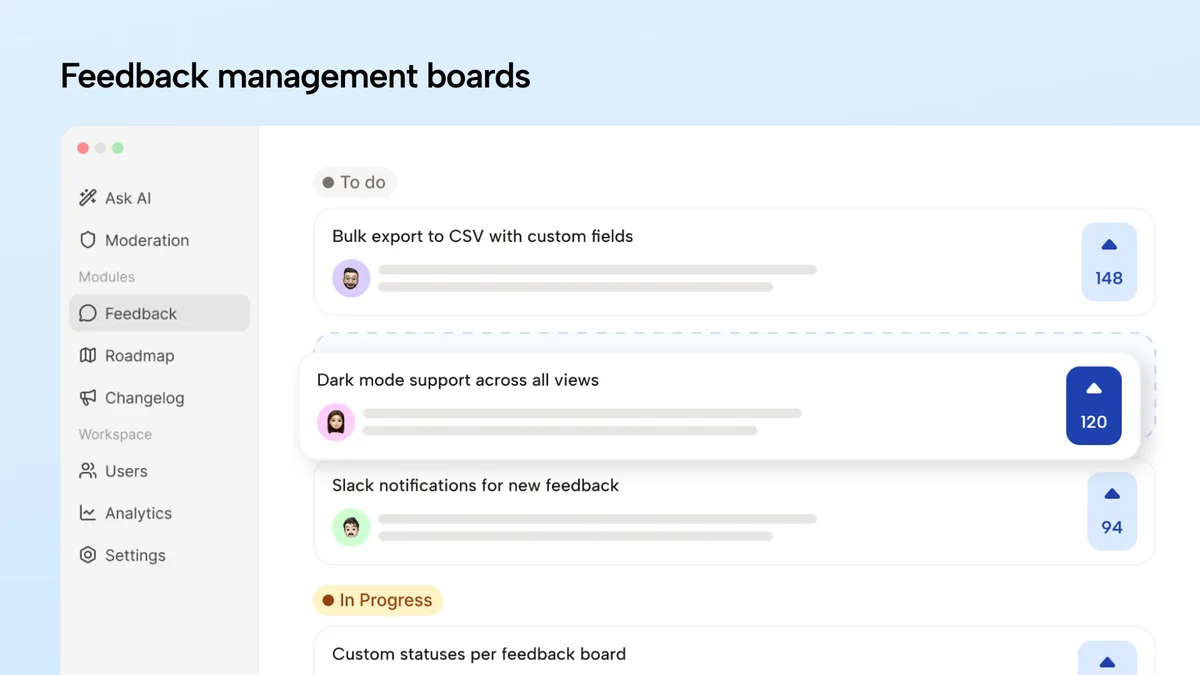
The first buying decision is whether you need one product team or several separate organizations. Tier 1 supports three team members and one organization. Tier 2 keeps one organization but permits ten members and adds insights, customer segments, APIs and webhooks. Those feature gates can matter before you reach any numeric limit.
Tier 3 allows three organizations with fifteen members and 500 monthly AI credits per organization. Tier 4 raises the organization allowance to ten with the same per-organization member and monthly-credit figures. The table lists a separate 500-credit one-time bonus on both; it does not explicitly multiply that bonus by the number of organizations.
For a two-person SaaS collecting suggestions on a public board, Tier 1 is a reasonable starting point. If the workflow must send selected requests to an internal system through an API, choose Tier 2 even with only two staff. An agency managing four unrelated products needs to examine Tier 4 organization separation rather than inviting everybody into one shared company.
Support volume is another tier decision
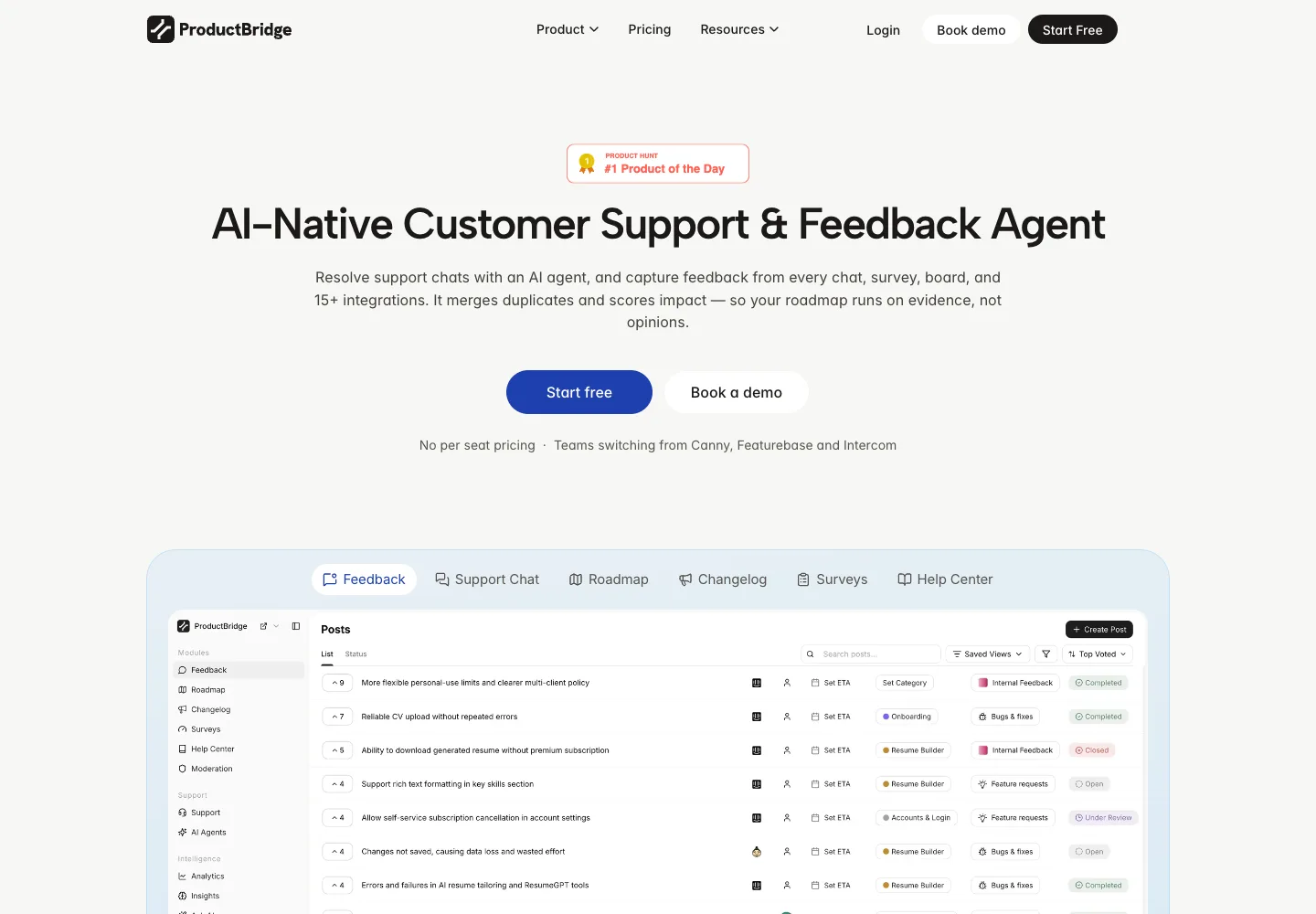
The offer has expanded beyond its original feedback-board positioning. It now lists support chat, a help center and surveys. Tier 1 has 150 support conversations per month, 100 help articles and three active surveys. Tier 2 raises those to 500, 500 and ten. Higher tiers remove the listed conversation and article caps, while Tier 3 still has a 25-survey ceiling.
Count conversations in the month you are likely to be busiest, not only a quiet average. A launch that creates 180 support conversations already exceeds Tier 1 even if the board contains very few feature requests. Keep human handling and escalation in the evaluation: a generated reply must not silently commit your company to a refund, delivery date or promised feature.
The August founder update says support, help-center and survey features are live, superseding July answers that called them upcoming. Those features may cover only part of an existing helpdesk’s workload. Test the channels and record exports your team actually uses.
Do not treat unlimited feedback as unlimited analysis
Boards and tracked users are advertised without a numeric cap, but AI remains metered. Monthly allowances and the one-time bonus are distinct balances. The founder says separately purchased top-ups do not expire; their current prices are displayed inside the billing screen.
The founder answer says BYOK is not on the roadmap. You cannot assume that connecting your own model account avoids ProductBridge credit limits. Nor did the available evidence settle a universal cost per feedback item or monthly-credit rollover. A planning exercise should therefore count the actual actions required—ingestion, grouping, summaries and follow-up—then compare observed account usage during evaluation.
Keep a small reference set of requests that deliberately includes duplicates, contrasting customer needs and different wording for the same issue. Review what the AI merges before allowing its summaries to drive a roadmap. Ten votes from a narrow segment can be less important than a single blocker for a core workflow; the software organizes evidence but does not make that business decision.
Move customer context, not just a list of titles
The official site describes CSV import for feedback, votes and users. Prepare a copy of the existing export and map its customer identifiers, statuses and privacy settings before importing a complete history. A successful import count is insufficient if votes lose attribution or private requests become public.
Link a request to a roadmap item, change its state and publish a small changelog entry. Confirm which customer receives the notification and what appears on the public portal. This evaluates the full reason for adopting the product: closing the loop with the person who asked, rather than merely creating another backlog.
The included custom domain is useful for a public feedback portal, but it is not proof of unrestricted white-label resale, independent customer billing or permissioned client subaccounts. Settle those requirements before using a multi-organization licence as an agency service.
FEATURE COMPARISON
Features, limits and paid extras
“Included” and “unlimited” can mean different things. This checklist separates full access, usage limits, add-ons and features that are not confirmed.
Feature coverage4 / 10
4 fully included · 5 limited · 0 add-on · 0 not included · 1 not confirmed. Coverage is not a quality score.
Features are grouped by documented coverage. “Not confirmed” means the evidence is incomplete, not that a feature is absent.
Feedback & reviews: documented features and conditions
FEATURESFeature comparison
ProductBridgeLifetime deal
Included4 features
Product feedback boardsProduct feedback boards with product-specific scope and plan limits.
Included
Unlimited boards and tracked users.
Roadmaps and changelogsRoadmaps and changelogs with product-specific scope and plan limits.
Included
Public roadmap, custom status workflow and release notifications.
Website widgetsWebsite widgets with product-specific scope and plan limits.
Included
Embedded feedback widget plus support surfaces.
Custom domainCustom domain with product-specific scope and plan limits.
Included
Custom domain listed on all tiers.
Limited5 features
Public review synchronizationPublic review synchronization with product-specific scope and plan limits.
Limited
Public review sources can supply product feedback; two-way review synchronization is not established.
Response managementResponse management with product-specific scope and plan limits.
Limited
Support inbox and feedback follow-up; not an established public-review reply manager.
AI analysis and assistanceAI analysis and assistance with product-specific scope and plan limits.
Limited
Metered AI; insights from Tier 2.
Client or organization separationClient or organization separation with product-specific scope and plan limits.
Limited
One, three or ten organizations depending on tier.
API and automationAPI and automation with product-specific scope and plan limits.
Limited
MCP listed on all tiers; APIs/webhooks from Tier 2.
Not confirmed1 feature
Review request campaignsReview request campaigns with product-specific scope and plan limits.
Not confirmed
Public-review request campaigns are not established.
Check each product’s plan notes for tier limits and additional costs. Feature coverage is not a quality rating.
USE CASES
What problems does ProductBridge solve?
01
Turn repeated support requests into a decision
Feature requests arrive in several places and lose their customer context.
How to use it
Connect one supported source and import a small sample.
Review duplicate grouping and customer attribution.
Link a selected request to a roadmap item and notify its followers after release.
What this helps you do: A request can remain connected to its customer through planning and delivery.
Limitations: AI grouping needs review; source-service access and monthly AI allowances still apply.
02
Separate feedback for several products
An agency needs unrelated product boards and staff permissions.
How to use it
Count organizations and users per organization.
Configure private/public visibility with sample requests.
Check a user from each organization cannot see unrelated private work.
What this helps you do: Organization-based plans can support separate feedback spaces.
Limitations: Do not infer unrestricted resale or shared credit pooling from organization count.
BUYER FEEDBACK
What buyers say
Buyer experiences can vary with the plan, product version and workflow.
Mixed feedback
A small, mixed feedback sample
The listing has three reviews. Two praise onboarding or connected feedback collection. A third discloses paid AppSumo testing and a free licence; its update says earlier beta concerns were addressed. The small sample does not establish reliability at scale.
ProductBridge images
When a free board is the better starting point
ProductBridge publishes a free option with one feedback board, public roadmap, changelog and duplicate detection. For a new product with few requests, first document how you will review feedback and notify customers; buying more capacity does not solve an unowned process. Existing-account eligibility matters, however: the AppSumo terms restrict this deal to brand-new users, including no previous trials. Clarify that rule before opening an account solely to evaluate the lifetime purchase.
Canny and Featurebase are relevant alternatives when an established migration route, a particular integration or a specific support workflow matters more than paying once. More Good Reviews solves a different job—asking customers for public business reviews. It is not a substitute for a product roadmap, and ProductBridge is not automatically a public-review campaign manager.
The licence must be activated within sixty days. Upgrades are available while the deal is live and downgrades within sixty days; the refund window is also sixty days. Future AI models may require a paid add-on. Budget any required existing Slack, helpdesk or messaging subscriptions separately rather than treating an integration logo as a free account with that service.